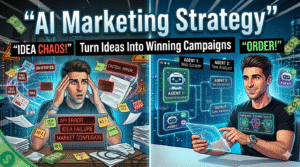
If you don’t have a structured, you’re basically guessing your way through marketing.
Most people start with ideas but fail because they don’t convert them into a clear system. A strong AI marketing strategy for campaigns fixes that problem by turning messy ideas into structured execution.
This guide breaks down a proven AI marketing strategy for campaigns using research, audience insight, messaging, and storytelling.
How to Start an AI Marketing Strategy for Campaigns With Research
The first step in any AI marketing strategy for campaigns is understanding your market.
Tools like HubSpot provide research kits that help structure insights and prompts.
A strong AI marketing strategy for campaigns begins with competitor analysis, tone research, and identifying gaps in the market.
Without research, your AI marketing strategy for campaigns will lack direction and clarity.
How to Define Audience in an AI Marketing Strategy for Campaigns
A powerful AI marketing strategy for campaigns depends on knowing exactly who you are targeting.
AI tools like ChatGPT help build customer personas based on real data.
When building an AI marketing strategy for campaigns, you must identify motivations, emotions, and buying triggers.
A weak audience model destroys even the best AI marketing strategy for campaigns.
How to Build Messaging in an AI Marketing Strategy for Campaigns
Messaging is the core of any AI marketing strategy for campaigns.
Using AI, you can analyze reviews, DMs, and feedback to understand customer language.
In a strong AI marketing strategy for campaigns, emotional tone matters more than features.
If your AI marketing strategy for campaigns doesn’t reflect customer emotion, it won’t convert.
How to Create Brand Story in an AI Marketing Strategy for Campaigns
Storytelling transforms a basic AI marketing strategy for campaigns into something memorable.
Brands like Google and others use structured storytelling to build emotional connection.
A strong AI marketing strategy for campaigns uses narratives, not just product descriptions.
Without storytelling, your AI marketing strategy for campaigns feels generic.
How to Design Visual Identity in an AI Marketing Strategy for Campaigns
Visual consistency is essential in any AI marketing strategy for campaigns.
AI tools can generate mood boards, color palettes, and brand guidelines instantly.
A complete AI marketing strategy for campaigns ensures visuals match tone and audience expectations.
If visuals don’t align, your AI marketing strategy for campaigns loses impact.
How HubSpot Uses AI Marketing Strategy for Campaigns
A real example of AI marketing strategy for campaigns comes from HubSpot Loop Marketing system.
They use structured prompts to build audience insights, messaging, and campaign direction.
This proves that an AI marketing strategy for campaigns is not theory—it is already in use.
Ignoring this AI marketing strategy for campaigns approach puts brands behind competitors.
Final Thoughts on AI Marketing Strategy for Campaigns
A strong AI marketing strategy for campaigns is not just about tools.
It’s about clarity, structure, audience understanding, and emotional storytelling.
If you apply an AI marketing strategy for campaigns correctly, your ideas turn into full campaigns faster and with better results.
Most importantly, every successful brand today uses some form of AI marketing strategy for campaigns.
External Links
- HubSpot: https://www.hubspot.com
- Google: https://www.google.com


Leave a Reply