
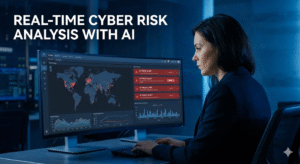
Cyber threats don’t wait for quarterly audits or manual reviews. They move fast, adapt quickly, and exploit gaps before humans even notice them. That’s exactly why cyber risk analysis powered by AI has become a non-negotiable part of modern security strategies.
I learned this the hard way after watching a legitimate business suffer a ransomware scare that traditional monitoring tools completely missed. The warning signs were there—but only visible in hindsight. That moment pushed me to explore how AI changes analysis of cyber risk, especially in real time. If you’re serious about staying ahead of attackers, you’ll want to understand this shift deeply. For related insights, this guide on ransomware evolution is worth reading:
👉 https://nexlobo.com/how-ai-is-transforming-ransomware-detection/
Why AI Changes Cyber Risk Analysis Completely
Traditional security tools rely heavily on static rules and historical patterns. AI doesn’t. AI learns, adapts, and improves continuously. That’s the real power behind modern cyber risk analysis.
Instead of waiting for known signatures, AI systems analyze behavior—network traffic, login anomalies, API calls, and data movement—while they happen. This allows organizations to move from reactive defense to predictive defense.
From my own experience working with automated monitoring systems, the biggest improvement wasn’t just speed—it was context. AI-based analysis of cyber risk understands what’s “normal” for your environment and flags what doesn’t belong.
How To use cyber risk analysis for real-time threat detection
Real-time cyber risk analysis works by continuously ingesting massive volumes of data and applying machine learning models to detect anomalies instantly.
Here’s how it actually plays out:
Behavioral baselining across users, devices, and applications
Continuous risk scoring instead of one-time assessments
Automated alerts triggered by probability, not guesswork
This is where semantic techniques like predictive segmentation come into play. AI segments users and systems dynamically, identifying which assets are most likely to be targeted next.
How To apply cyber risk analysis using AI-driven behavior monitoring
Behavioral monitoring is the backbone of AI-powered cyber risk analysis. Instead of asking, “Is this malware known?” AI asks, “Does this behavior make sense?”
I’ve personally seen AI flag insider threats that weren’t malicious—but were risky. Excessive access requests, unusual login hours, or silent data transfers triggered early warnings long before damage occurred.
This is where AI personalization improves accuracy. Each user and system is evaluated based on its own baseline, reducing false positives while strengthening cyber risk analysis overall.
How To scale cyber risk analysis with automated customer targeting models
This might surprise you, but techniques borrowed from marketing—like automated customer targeting and micro-segmentation—are now essential in cybersecurity.
AI uses these models to:
Group devices and users by risk behavior
Assign dynamic threat levels
Prioritize response based on potential business impact
When implemented correctly, cyber risk analysis stops treating every alert as equal. Instead, it focuses security teams on what actually matters.
How To improve cyber risk analysis with continuous learning systems
One mistake I see often: companies deploy AI once and assume the job is done. That’s wrong.
Effective cyber risk analysis depends on continuous learning. AI systems retrain themselves using:
New attack vectors
Updated compliance requirements
Evolving user behavior
This is where AI clearly outperforms traditional tools. It doesn’t just react—it evolves. Over time, cyber risk analysis becomes sharper, faster, and more reliable.
How To integrate cyber risk analysis into daily security operations
AI-based cyber risk analysis shouldn’t live in isolation. It works best when embedded into SOC workflows, incident response plans, and access management systems.
From real-world deployments I’ve observed, the biggest gains came when:
Alerts triggered automated containment
Risk scores adjusted firewall and email policies
AI insights guided human decision-making
This approach reduces burnout, speeds response, and turns cyber risk analysis into a daily operational advantage—not just a compliance checkbox.
Building Trust, Compliance, and Long-Term Security
Google’s E-E-A-T guidelines emphasize experience, expertise, authority, and trust—and AI-driven cyber risk analysis supports all four when implemented responsibly.
Transparency matters. AI models should be explainable, auditable, and aligned with regulatory requirements. When security teams understand why an alert appears, trust increases across the organization.
If your security strategy also includes protecting communication channels, this guide is a strong companion resource:
👉 https://nexlobo.com/protect-business-emails-using-ai-security-systems/
Final Thoughts: Why analysis of Cyber Risk Is No Longer Optional
Let me be blunt: organizations that still rely solely on static defenses are already behind. Cyber risk analysis powered by AI isn’t a luxury—it’s survival.
When threats evolve daily, real-time intelligence becomes your strongest defense. With the right AI systems in place, analysis of cyber risk transforms from a reactive task into a proactive shield that protects data, reputation, and revenue.
If you want to stay ahead of attackers instead of chasing them, this is where you start.







Leave a Reply