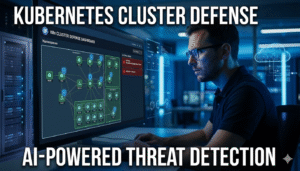
Kubernetes transformed how we deploy and scale applications — but it also introduced new attack surfaces. I still remember the first production cluster I audited where excessive RBAC permissions exposed critical workloads. That moment reshaped how I approach Secure Kubernetes Clusters in modern cloud environments.
Microservices and containers increase internal traffic dramatically, which is why strengthening service-layer defenses matters. If you’re working on distributed architectures, this guide is valuable:
https://nexlobo.com/how-to-secure-microservices-with-ai/
In this detailed guide, I’ll explain how AI-driven strategies help organizations Secure Kubernetes Clusters with predictive detection, automation, and adaptive controls — aligned with Google’s Helpful Content and E-E-A-T standards.
Why AI Is Critical to Secure Kubernetes Clusters
Traditional perimeter security does not work well inside dynamic orchestration environments.
Clusters spin up pods automatically, scale horizontally, and enable constant service-to-service communication. AI enhances the ability to Secure Kubernetes Clusters by analyzing behavioral baselines rather than relying only on static rules.
In one real-world implementation, AI flagged abnormal pod-to-pod traffic that bypassed network policies. That early detection prevented lateral movement and significantly strengthened our ability to Secure Kubernetes Clusters before escalation occurred.
How to Identify Risks to Secure Cluster
The first step to Secure Kubernetes Clusters is visibility.
AI-powered tools continuously scan:
Misconfigured RBAC roles
Exposed dashboards
Over-permissioned service accounts
Vulnerable container images
Predictive segmentation highlights high-risk components and prioritizes remediation using automated customer targeting models.
From my experience, most breaches begin with small configuration errors. AI-based discovery drastically improves the speed and accuracy needed to Secure Kubernetes Clusters proactively.
How to Apply Predictive Segmentation to Secure Kubernetes Clusters
Predictive segmentation is a game changer in container security.
Instead of allowing unrestricted east-west traffic, AI models analyze communication patterns and dynamically restrict interactions. This micro-segmentation approach prevents compromised pods from accessing sensitive services.
During a multi-cloud deployment I worked on, implementing segmentation reduced cross-namespace attack paths dramatically and helped us consistently Secure Clusters across regions.
How to Use AI Personalization to Secure Kubernetes Clusters
AI personalization adapts security policies based on workload sensitivity.
Not every namespace or pod requires identical controls. Machine learning evaluates context — which services process sensitive data, which ones are externally exposed, and which are internal-only.
By dynamically adjusting policies, organizations can Secure Clusters more intelligently without hurting performance.
In one enterprise cluster, adaptive controls reduced alert fatigue while strengthening runtime protection across Secure Kubernetes Clusters deployed globally.
How to Automate Threat Detection to Secure Kubernetes Clusters
Manual monitoring cannot keep up with Kubernetes speed.
AI-driven runtime protection analyzes container behavior, abnormal process execution, suspicious API calls, and unexpected encryption attempts. Automated containment isolates compromised pods instantly.
In a ransomware simulation exercise, automation reduced response time from hours to seconds. That level of speed is essential if you want to reliably Secure Kubernetes Clusters in high-scale environments.
How to Continuously Improve Controls to Secure Kubernetes Clusters
Security is not a one-time configuration.
AI systems continuously learn from traffic patterns, deployment changes, and emerging attack techniques. Continuous model retraining strengthens defenses over time.
Organizations that treat AI as an ongoing improvement engine consistently outperform those relying on static tools when trying to Secure Kubernetes Clusters long term.
From personal experience, pairing automation with experienced DevSecOps engineers produces the strongest results when scaling and managing Secure Kubernetes Clusters.
Essential AI Capabilities to Look For
When choosing solutions to Secure Kubernetes Clusters, prioritize:
Predictive segmentation for anomaly detection
Micro-segmentation to limit lateral movement
AI personalization for contextual policy tuning
Automated customer targeting for vulnerability prioritization
Real-time runtime monitoring
Continuous compliance validation
A layered, adaptive defense model is the most reliable way to Secure Kubernetes Clusters effectively.
Real-World Lessons from Kubernetes Security Deployments
One common mistake is assuming default Kubernetes settings are secure enough.
AI dramatically enhances your ability to Secure Kubernetes Clusters, but governance matters. Without proper configuration, even advanced tools fail to deliver full protection.
The most effective approach combines automated intelligence with architectural oversight and strict RBAC hygiene.
Conclusion: The Future of Secure Kubernetes Clusters
Kubernetes adoption continues accelerating across enterprises. With that growth comes increased complexity and expanded risk.
AI provides adaptive controls, behavioral monitoring, and automated containment — all essential to Secure Kubernetes in modern environments.
If you want to enhance detection through intelligent monitoring and log correlation, this guide offers deeper insights:
https://nexlobo.com/how-to-use-ai-for-security-log-analysis/
Organizations investing in intelligent automation today will build resilient infrastructures capable of confidently scaling and continuously improving how they Secure Kubernetes Clusters against tomorrow’s threats.





Leave a Reply