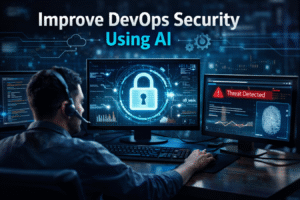
In my years working with DevOps teams, I’ve seen firsthand how overlooked security can lead to critical vulnerabilities. Leveraging AI has transformed our approach to detecting and mitigating threats. Using AI to transform ransomware detection has shown me that improving security in DevOps isn’t just about patching systems—it’s about predictive insights and proactive monitoring. AI helps teams improve DevOps security by automating repetitive checks, identifying risky patterns, and suggesting real-time mitigation strategies.
How To Identify Vulnerabilities and Improve DevOps Security
One of the first steps I took in improving DevOps security was integrating AI-powered vulnerability scanners. These tools continuously monitor code commits, deployment scripts, and infrastructure changes. With AI, we could detect misconfigurations or exposed secrets instantly. Implementing automated alerting allows teams to act faster, which significantly boosts the ability to improve DevOps security.
How To Automate Threat Detection to Improve DevOps Security
AI-driven threat detection uses predictive models to flag unusual activity before it escalates. I remember a time when our monitoring system flagged an unusual spike in container traffic. The AI suggested a possible insider misconfiguration, and we mitigated it before it became a problem. This hands-on experience showed me how crucial it is to improve DevOps security with automated systems that learn from past incidents.
How To Enhance Continuous Integration/Continuous Deployment Pipelines for Security
Integrating AI into CI/CD pipelines ensures that vulnerabilities are caught before deployment. For example, AI can analyze dependencies for known exploits, enforce compliance checks, and even simulate attacks to predict risks. By using AI in this manner, teams can consistently improve DevOps security, minimizing the chances of introducing weaknesses in production environments.
How To Use Predictive Analytics to Improve DevOps Security
Predictive analytics powered by AI allows us to forecast potential threats based on historical data. In one instance, predictive segmentation helped us identify which microservices were most at risk during updates. Implementing these insights drastically improved our overall security posture and helped the team improve DevOps security with data-backed decisions.
How To Train Teams to Collaborate With AI for DevOps Security
Even with advanced AI tools, human collaboration remains key. Educating teams on interpreting AI alerts, responding to risks, and incorporating AI recommendations into workflows ensures maximum effectiveness. Through training sessions and real-world drills, we learned how to improve DevOps security collectively, using AI as an assistant rather than a replacement.
How To Maintain Compliance and Documentation While Improving DevOps Security
Compliance is often an overlooked part of DevOps security. AI tools can track changes, log potential risks, and automatically generate audit-ready reports. Incorporating this into our DevOps strategy ensured we could improve DevOps security while meeting regulatory requirements. These tools also complement email and internal communications security strategies, as shown in protect business emails using AI security systems.
Conclusion:
Adopting AI in DevOps has been a game-changer. From predictive threat modeling to automated vulnerability scanning, these tools help teams improve DevOps security efficiently and proactively. The combination of AI insights and skilled human intervention ensures a resilient, compliant, and secure environment.






Leave a Reply