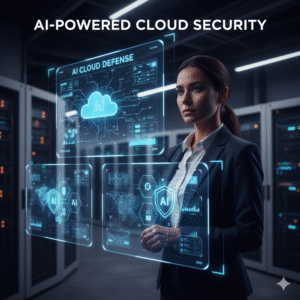
Cloud environments are powerful — but they are also complex and constantly exposed. I realized this during a migration project where a misconfigured container exposed sensitive workloads for hours before anyone noticed. That experience completely changed how I approach cloud workload protection today.
As organizations expand into multi-cloud and hybrid infrastructures, traditional perimeter defenses fail to keep up. Strengthening your broader remote strategy is essential, and you can explore modern remote defense systems here:
https://nexlobo.com/best-ai-solutions-for-remote-work-security/
In this guide, I’ll break down the most effective AI-driven tools transforming cloud workload protection, along with real-world lessons from hands-on implementation.
Why AI Is Essential for Cloud Workload Protection
Cloud environments are dynamic. Workloads spin up and down automatically. Static rule-based security simply cannot adapt fast enough.
AI enhances cloud workload protection through behavioral monitoring, predictive segmentation, and real-time anomaly detection. Instead of relying on signatures, AI understands normal workload behavior and flags deviations instantly.
In one deployment I worked on, AI detected unusual API call patterns that would have gone unnoticed with traditional monitoring. That early detection strengthened overall cloud workload protection and prevented lateral movement.
1. Palo Alto Prisma Cloud – AI-Powered Visibility
Prisma Cloud combines AI analytics with compliance automation. It continuously monitors containers, VMs, and serverless functions to improve cloud workload protection.
Its micro-segmentation capabilities isolate suspicious workloads without shutting down entire environments. From my experience, this precision dramatically reduces operational disruption while maintaining strong cloud workload protection.
2. CrowdStrike Falcon Cloud Security
CrowdStrike extends endpoint AI intelligence into cloud-native workloads. It uses predictive analytics to detect runtime anomalies.
One organization I advised saw immediate improvements in cloud protection after deploying Falcon’s behavioral engine. Instead of waiting for alerts, the system automatically prioritized high-risk threats through automated customer targeting models.
3. Microsoft Defender for Cloud
Microsoft’s AI engine provides continuous risk assessment and adaptive threat detection across Azure and hybrid environments.
AI personalization reduces alert fatigue while enhancing cloud workload protection through contextual analysis. This balanced approach makes it especially effective for large enterprises managing thousands of workloads.
4. Lacework – Behavioral Cloud Monitoring
Lacework focuses heavily on behavioral baselining. It builds a dynamic model of workload activity and detects anomalies across accounts.
I’ve seen Lacework stop suspicious privilege escalations in real time, significantly improving cloud workload protection across multi-cloud setups.
Its predictive segmentation engine isolates high-risk processes before attackers can escalate access.
5. Check Point CloudGuard
CloudGuard integrates threat intelligence with AI-driven automation. It analyzes workload behavior, detects configuration drift, and enforces security policies dynamically.
In a financial services environment, CloudGuard strengthened cloud protection by automatically correcting risky misconfigurations — something manual audits often miss.
6. Orca Security – Agentless AI Protection
Orca uses agentless scanning combined with AI risk scoring. This reduces deployment complexity while maintaining strong cloud workload protection.
Its unified visibility across workloads, storage, and identities makes it particularly useful in environments where rapid scaling occurs.
Key Features to Look for in Cloud Workload Protection Tools
When evaluating solutions, prioritize:
Predictive segmentation to anticipate risks
Micro-segmentation to contain compromised workloads
AI personalization for contextual alerts
Automated customer targeting for prioritization
Runtime behavioral monitoring
Continuous compliance assessment
Effective cloud protection is about speed, automation, and intelligent containment.
Challenges Organizations Overlook
AI is powerful, but it must be properly configured. Over-automation without governance can introduce blind spots.
The most effective cloud workload protection strategies combine machine intelligence with experienced cloud architects. AI handles pattern detection at scale; humans interpret complex context.
In my experience, organizations that treat cloud protection as an ongoing strategy — not a one-time setup — achieve far stronger resilience.
The Future of Cloud Workload Protection
Cloud infrastructure will only grow more complex. Containers, Kubernetes, and serverless architectures expand the attack surface daily.
AI-driven cloud workload protection is no longer optional. It is foundational. Organizations that implement intelligent monitoring, adaptive controls, and automated remediation today will significantly reduce risk tomorrow.
For deeper insights into ransomware resilience within cloud environments, explore:
https://nexlobo.com/best-ai-tools-for-ransomware-detection/
The combination of AI-driven ransomware detection and advanced cloud workload protection creates a layered defense strategy capable of handling modern threats.


Leave a Reply