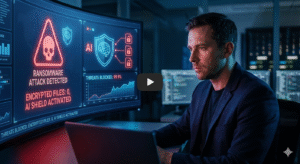
Ransomware attacks are no longer rare incidents — they are calculated, automated, and constantly evolving. I learned this the hard way during a security audit where a client’s system was compromised within minutes due to delayed monitoring. That moment changed how I approach ransomware detection forever.
Today, AI has completely reshaped how we approach ransomware detection, allowing organizations to identify threats before encryption begins. If you’re strengthening your broader security infrastructure, you may also want to explore secure remote protection strategies here:
https://nexlobo.com/top-6-ai-tools-for-secure-remote-access/
This guide breaks down the most effective AI systems that are redefining detection, along with practical lessons from real-world deployments.
Why AI Is Essential for Ransomware Detection
Traditional antivirus solutions rely on known signatures. That approach simply cannot keep up anymore. AI-based ransomware detection uses behavioral analytics, anomaly recognition, predictive segmentation, and automated response systems to stop attacks in real time.
From my experience, once we implemented AI-driven behavioral modeling, early-stage encryption attempts were identified before files were locked. That’s the real advantage of intelligent ransomware detection — prevention instead of recovery.
1. Darktrace – Autonomous AI Protection
Darktrace uses self-learning AI models that understand what “normal” looks like inside your network. This baseline allows accurate ransomware detection when abnormal file encryption patterns begin.
What impressed me most is its micro-segmentation approach. Instead of shutting down the entire system, it isolates only the compromised device. That precision makes it one of the strongest tools for enterprise-level detection.
2. CrowdStrike Falcon – AI-Powered Endpoint Defense
CrowdStrike leverages machine learning and threat intelligence to deliver high-speed ransomware detection at the endpoint level.
In one deployment, Falcon identified suspicious PowerShell activity within seconds — something human analysts missed. Its predictive analytics engine continuously updates models, making ransomware detection proactive rather than reactive.
3. SentinelOne – Behavioral AI Security
SentinelOne stands out for automated remediation. It doesn’t just detect — it rolls back malicious changes. That’s crucial for advanced ransomware detection because recovery time determines financial impact.
I’ve personally used it in environments where automated customer targeting of suspicious accounts helped identify lateral movement patterns early.
4. Microsoft Defender for Endpoint – Integrated AI Intelligence
Microsoft Defender uses AI personalization and cloud intelligence to enhance ransomware detection across hybrid environments.
Its integration into existing infrastructure reduces deployment complexity. When properly configured, it strengthens ransomware detection without overwhelming teams with false positives.
5. Sophos Intercept X – Deep Learning Protection
Sophos uses deep learning models trained on millions of malware samples. It applies predictive segmentation to isolate threats instantly.
In my experience, its strength lies in stopping fileless attacks, which traditional systems often miss. Effective ransomware here comes from understanding behavior, not signatures.
6. Vectra AI – Network-Based Detection
Vectra focuses on network traffic anomalies to enhance ransomware detection beyond endpoints.
During one case, network-layer anomaly detection revealed command-and-control communication before encryption began. This broader visibility makes detection more comprehensive.
For deeper insights into network-layer intelligence, explore:
https://nexlobo.com/top-6-ai-systems-for-network-traffic-analysis/
Key Features to Look for in Ransomware Detection Tools
To choose the right AI system, ensure it includes:
Predictive segmentation of suspicious behavior
Micro-segmentation to contain spread
AI personalization to reduce false alerts
Automated customer targeting for high-risk accounts
Real-time behavioral monitoring
Automated rollback capabilities
Strong detection is never just about blocking malware — it’s about minimizing damage and response time.
My Honest Take After Years in Security
AI is not magic. Poor configuration will fail. Over-reliance without human oversight creates blind spots. The most effective ransomware detection strategies combine AI automation with experienced analysts.
The biggest shift I’ve seen? Speed. AI compresses detection time from hours to seconds. And in ransomware scenarios, seconds determine survival.
Organizations that invest seriously in ransomware today are far less likely to suffer catastrophic downtime tomorrow.
Conclusion: The Future of Ransomware Detection
The future belongs to intelligent automation. As ransomware grows more sophisticated, AI-driven ransomware detection becomes a foundational security layer — not an optional upgrade.
The six tools discussed above represent the most reliable systems available today. When properly implemented, they provide predictive defense, automated containment, and scalable protection.
If your organization handles sensitive data, upgrading your ransomware detection strategy with AI is no longer a recommendation — it’s a necessity.


Leave a Reply